
Exploring how we remember, pay attention, imagine, and participate in our own lives.
Our memories are not simply reservoirs of content. They are part of the ways we live in the world.
What we remember, what we forget, what captures our attention, and what we imagine all contribute to the ways we understand ourselves.
Psychotherapy can create a space to explore these relationships—not necessarily because something needs to be corrected, but because becoming curious about the mind can change how we experience our lives.
Our work brings together psychotherapy, memory, attention, imagination, learning, and everyday experience.
The goal is not to remember everything.
It is to discover how you can live more fully with the mind and memory you have.
A Different Relationship With Memory
Most of us rarely stop to consider that we have a relationship with our own memory.
We notice memory when it fails us. We notice the forgotten appointment, the missing name, the word we cannot find, or the experience that has become difficult to reconstruct.
But memory is present in far more than moments of forgetting.
It participates in the stories we tell about ourselves.
It shapes our expectations.
It connects places with experiences, people with emotions, and our present lives with everything that came before them.
Rather than treating memory simply as a cognitive ability that performs well or poorly, we become interested in the relationship itself.
How do you communicate with your memory?
What does it respond to?
What helps it become engaged?
What are you trying very hard not to forget?
And what might you be ready to let go?
These questions can become the beginning of therapeutic exploration.
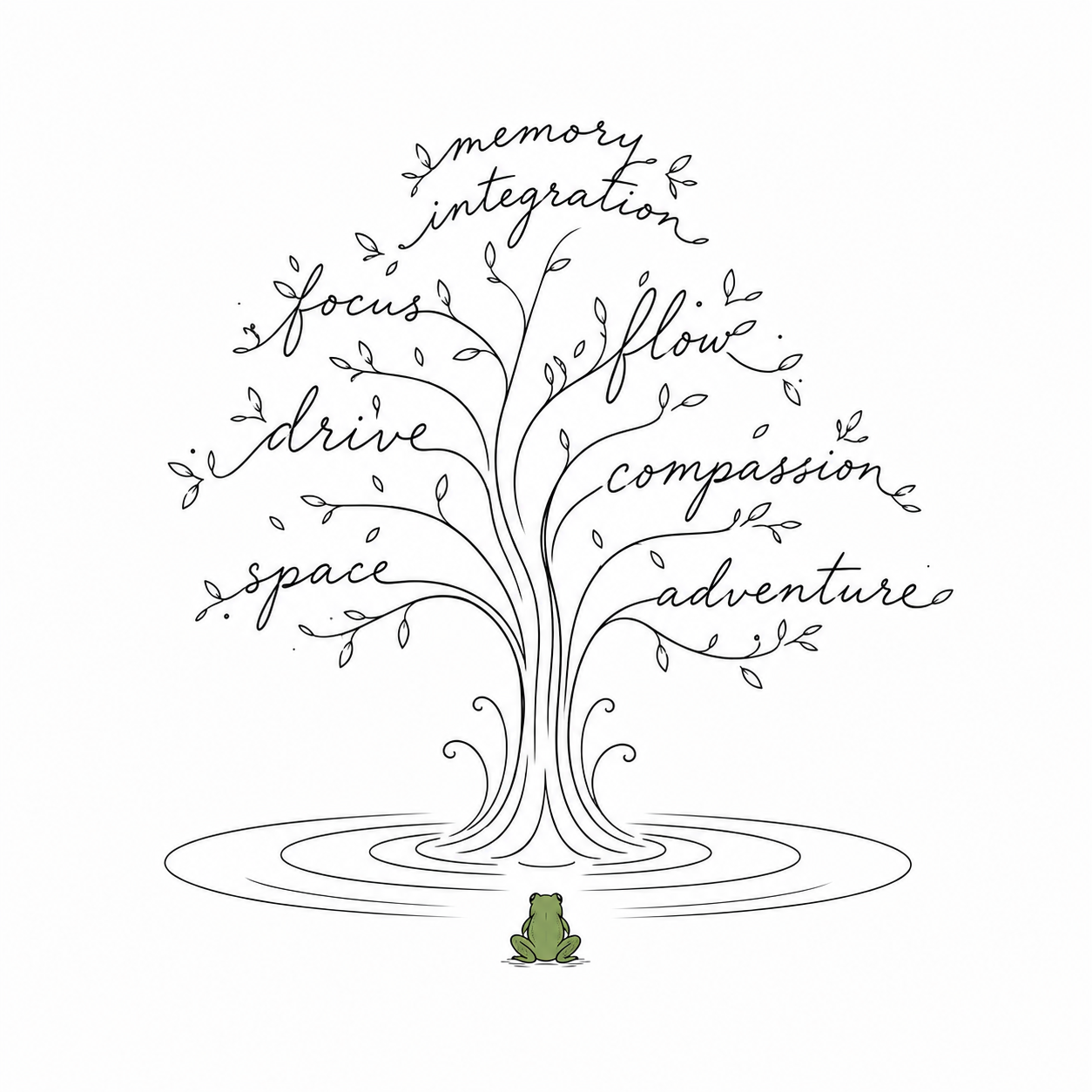
Focus
What happens when we begin to notice what captures our attention?
Attention and memory are deeply connected.
Before we can remember something, we first have to encounter it. We have to notice it long enough for the experience to become meaningful.
Yet our attention is constantly moving.
We think about what happened yesterday while preparing for tomorrow. We move between conversations, screens, responsibilities, memories, worries, and expectations.
Sometimes difficulties with remembering begin much earlier than the moment we try to recall something.
They begin with how we were paying attention.
Our work explores the environments, experiences, emotions, and activities that allow your attention to become naturally engaged.
Rather than asking only:
How can I concentrate harder?
we may also ask:
What makes my mind want to stay?
Memory Integration
Remembering is more than retrieving information.
Some memories exist as clear stories.
Others appear as fragments—a feeling, an image, a place, a bodily sensation, a sentence, or something we cannot completely explain.
Memory integration involves exploring how these experiences exist within the larger story of our lives.
This does not necessarily mean recovering every detail of the past.
Instead, we may explore how memories are understood, repeated, reorganized, expressed, and connected with present experience.
Through conversation, storytelling, observation, writing, imagination, and other forms of exploration, experiences can sometimes be encountered from new perspectives.
The past does not change.
But our relationship with it can.
Flow
Creating conditions in which the mind can become absorbed.
There are moments when attention stops feeling like effort.
We become immersed in writing, gardening, walking, drawing, reading, playing music, solving something, having a conversation, or simply observing the world around us.
Time seems different.
Attention becomes quieter.
We are engaged without constantly reminding ourselves to be engaged.
These experiences can help us understand something important about our minds.
Rather than focusing exclusively on moments when attention becomes difficult, we also become curious about moments when attention happens naturally.
What are you doing when you lose track of time?
What environments allow your mind to settle?
What kinds of challenges stimulate rather than overwhelm you?
What makes curiosity appear?
Understanding these conditions can help us create more opportunities for meaningful engagement in everyday life.
Drive
What makes something worth remembering?
Memory is selective.
Some experiences disappear quickly while others remain vivid for years.
Emotion, meaning, novelty, repetition, attention, and personal relevance can all influence what remains available to us.
This is why motivation matters.
Rather than repeatedly forcing ourselves to remember things that feel disconnected from our lives, we can explore what creates genuine interest and engagement.
Sometimes the question is not:
How do I make myself remember this?
It is:
How do I make this worth remembering?
That shift can change the way we approach learning, attention, and everyday memory.
Compassion
Curiosity can be more useful than criticism.
Forgetting can be frustrating.
Difficulty concentrating can be frightening.
Changes in our cognitive abilities can make us impatient with ourselves.
But constant self-monitoring can turn every forgotten word or misplaced object into evidence that something is wrong.
Our approach makes room for another response.
Curiosity.
Instead of immediately asking, What is wrong with me?, we can begin asking:
What was happening when I forgot?
Was I distracted?
Was I tired?
Was the information meaningful to me?
What would help next time?
Compassion does not mean ignoring difficulties.
It means creating enough space to understand them without turning every difficulty into a judgment about ourselves.
Space
Not every moment needs to be filled.
Our minds are surrounded by information.
Messages arrive.
Screens change.
Tasks accumulate.
Something is almost always asking for our attention.
Yet memory and imagination also need space.
Space to wander.
Space to associate.
Space to notice something without immediately responding to it.
Space to forget.
Space to remember.
Space to become bored enough for an unexpected thought to appear.
Part of our work may involve exploring what happens when we intentionally create these quieter spaces.
Sometimes the mind does something interesting when we stop telling it exactly what it should be doing.
Adventure
Learning can become experiential again.
Not all therapeutic work needs to happen through conversation alone.
Sometimes understanding emerges through experience.
A walk somewhere unfamiliar.
A creative project.
A memory experiment.
A conversation you have been postponing.
Learning something simply because you are curious about it.
Returning to a meaningful place.
Doing something differently enough that you begin paying attention again.
We sometimes think of these experiences as small adventures—personally meaningful experiments that bring therapeutic exploration into everyday life.
They do not need to be dramatic.
The purpose is simply to create an experience worth noticing.
Imagination
Memory looks backward. Imagination allows us to look elsewhere.
Human beings do not live entirely inside what has already happened.
We anticipate.
We invent.
We rehearse conversations that have not occurred.
We imagine people we might become and lives we might someday live.
Imagination allows psychotherapy to move beyond explaining the past.
It gives us a place to experiment with possibility.
We may work with storytelling, writing, dreams, imagery, improvisation, fantasy, creative exercises, or imagined futures.
There does not always need to be an interpretation.
Sometimes imagination is valuable simply because it expands what feels possible.
If memory helps us understand where we have been, imagination can help us explore where we have not yet gone.

A Collaborative Mental Gym
Traditional psychotherapy often creates space for telling the story of our difficulties to another person.
There can be enormous value in being heard.
We are also interested in what happens when psychotherapy becomes something complementary: a place where two people actively experiment with attention, memory, imagination, learning, and experience.
A session might involve conversation.
Another might involve writing.
We might explore a memory, create a story, notice bodily sensations, experiment with attention, work with an external memory system, imagine something, or design a small experience to try between sessions.
There is no single exercise everyone must complete.
The process is collaborative.
You bring your experience. We become curious about it together.
What This Work May Include
Depending on what becomes meaningful to you, our work may involve personal storytelling, intentional memory integration, attention exercises, imagination and creative work, dream exploration, writing, collaborative storytelling, practical memory strategies, observation of bodily sensations, compensatory learning methods, environmental cues, reminders, improvisation, or personally meaningful experiments outside the therapy room.
The methods themselves are not the destination.
They are ways of discovering how your particular mind responds to experience.

Remember Yourself
Perhaps developing a healthier relationship with memory is not about holding onto everything.
Perhaps focus is not about forcing ourselves to pay attention every moment.
And perhaps psychotherapy does not always have to begin with something that needs to be fixed.
It can begin with curiosity.
What captures your attention?
What do you remember?
What are you learning to forget?
What brings you into flow?
What are you still able to imagine?
And, underneath all of those questions: